The Best Coding App for 7-Year-Olds (No Typing, No Reading Required)
Buildaloo is a voice-first AI game maker built for 7-year-olds who can talk long before they can type. Your child describes the game. Loo (our AI buddy) builds it. Ready to play on an iPad in minutes.
Try the Buildaloo Voice-First DemoFree while in beta. No credit card required.
Can a 7-year-old really make a video game without coding?
A 7-year-old has the imagination of a game designer and the patience of a 7-year-old. What they don't have is a thousand-word vocabulary, a touch-typing muscle, or the focus to wrestle with drag-and-drop coding blocks.
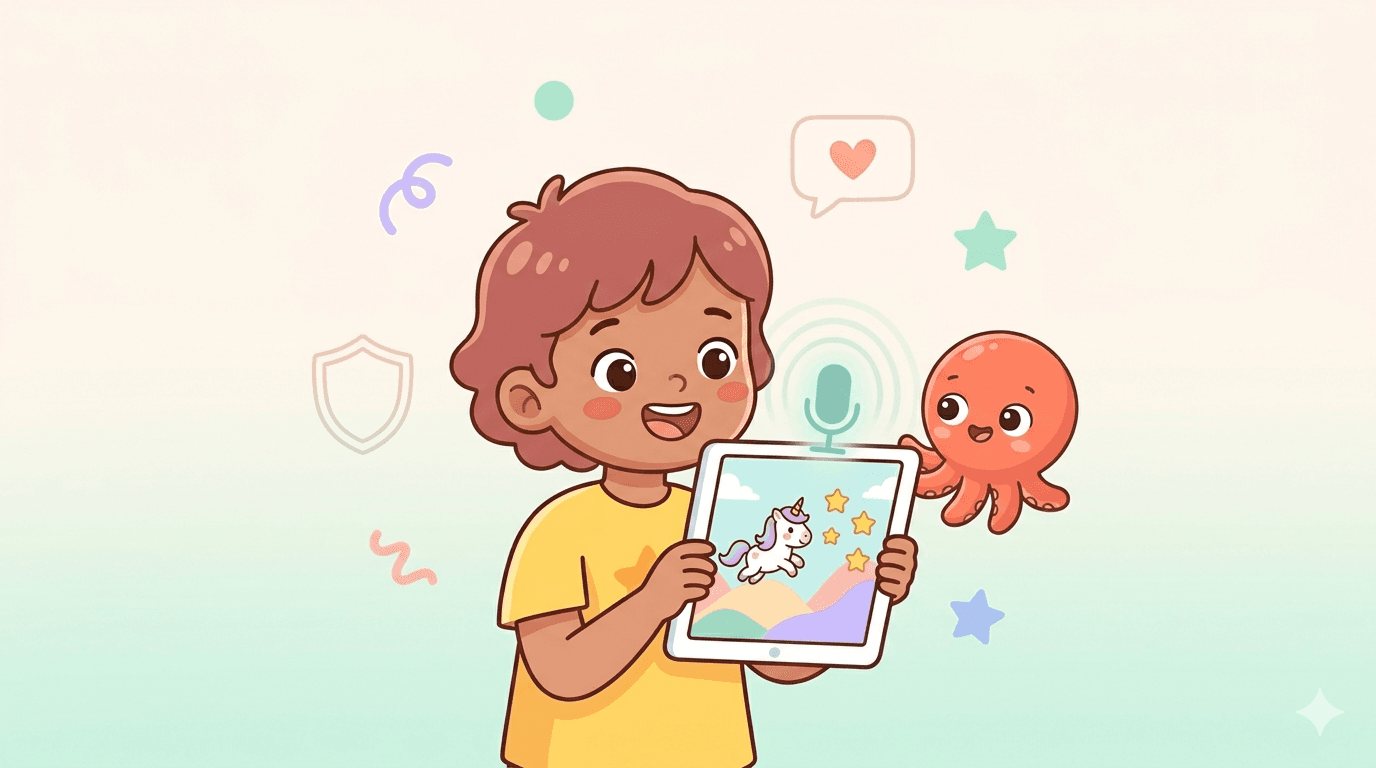
Buildaloo removes every one of those barriers. Your child presses the microphone and says: “I want a game where a unicorn collects stars.” Loo asks follow-up questions in plain English, builds the game in the background, and serves it back ready to play. This is vibe coding, the biggest shift in kid-made games since Scratch.
Is AI safe for my 7-year-old?
This is the first question most parents ask, and it's the right one. Buildaloo was designed from day one for children ages 5 to 12, and safety is the default, not a feature you configure. Following AAP guidance on children and media, we built the guardrails in, not on top.
- COPPA-compliant by design. We follow the US Children's Online Privacy Protection Act and the UK's Age-Appropriate Design Code. No third-party tracking, no ad targeting, verified parent consent for every account.
- No chat with strangers. Ever. Your child talks to Loo. That is the only conversation. No multiplayer lobbies, no public servers, no direct messages, no usernames that can be found.
- A monitored AI, not an open chatbot. Loo is tuned for creative game-making with a child. Off-topic conversations are redirected. Harmful, scary, or inappropriate content is filtered before it reaches your child.
- A parent dashboard for full visibility. Every game your child makes, every conversation they have with Loo, every session length, visible to you. Daily limits are one tap away.
What will my 7-year-old actually build?
The nine game types inside Buildaloo. Your child picks one and describes a theme. Loo handles the rest. These are the exact nine types in the product.
Quiz
Trivia about the family dog, planets, or their favorite show. Friday-night playable.
Memory
Classic flip-card matching with photos of grandparents or favorite characters.
Art
A drawing canvas with their own stamps and brushes. More creative tool than game.
Story
Choose-your-own-adventure with a hero and a few forks. Great for kids who love books.
How is this different from Scratch, Roblox, and Tynker?
Honest comparisons. Each tool is good at something, and most weren't built for 7-year-olds. For a longer read, see our guide to six safer Roblox alternatives, the 7 best Scratch alternatives, and Tynker vs Buildaloo.
Roblox
Them: A place to play games strangers made, with open chat.
Buildaloo: A place your child makes their own games. No chat with strangers. Ever.
Scratch & ScratchJr
Them: Block-based coding. Requires reading and precise drag-and-drop.
Buildaloo: Voice-first. Your child describes what they want. Loo handles the blocks behind the scenes.
Tynker & Kodable
Them: Puzzle-style coding lessons that teach a curriculum.
Buildaloo: Open-ended creation. Your child builds what's in their head. No syllabus, no gates.
Works for Year 2, 2nd Grade, and every primary-school child in between
Whether your child is in Year 2 at a UK or Australian primary school, 2nd grade at a US elementary school, or starting Key Stage 1, Buildaloo is built for how they actually talk, imagine, and play today.
The Australian national curriculum calls it Digital Technologies. The UK calls it Computing. In the US, it's loosely bundled under STEM. Whatever the label, every schooling system is starting to ask 7-year-olds to think computationally, and Buildaloo gives them the lowest-barrier way in, before they can read instructions or touch-type.
Mum, mom, dad, tutor, homeschooler, grandparent. Set up the iPad once, and your child can use it independently on a Saturday morning and show you a new game by lunch.
Frequently asked questions
Your 7-year-old is ready to build. Let's go.
Try the Buildaloo Voice-First Demo. Your child describes the game, Loo builds it.
Try the Buildaloo Voice-First DemoFree while in beta. Takes one minute to join.